ALS ADVOCACY

ALS ADVOCACY
Lou Gehrig's Disease - Motor Neuron Disease - Amyotrophic Lateral Sclerosis
Thought it had been cured by now? Still no known cause. Still no cure. Still quickly fatal. Still outrageous.

Wednesday, March 2, 2016

I Am No Longer Speechless

I was speechless when I saw the memo below last night.  I am no longer speechless.

Didn't any of the many powerful addressees say, "This is a horrible response to a serious problem and proposal?"

__________

https://www.change.org/p/tell-als-association-improve-home-care-for-als-patients/u/15675167

Barbara Newhouse's memo to ALSA
staff

Catherine Scott
Murrieta, CA
Mar 1, 2016 — Below you will find the content of a memorandum Barbara Newhouse sent to her staff prior to responding to my first letter. In it, she once again demonstrates a blatant indifference to the urgent home care issues facing ALS patients and their families today. Talking points, concern for stakeholders and a dismissal of the petition’s social media presence…How does that help us? We simply cannot tolerate the leader of the nation’s largest ALS advocacy organization not putting our needs first on her list of priorities.

******* Beginning of Memorandum *******
MEMORANDUM
The ALS Association
DATE February 24, 2016
TO National Board of Trustees - Chairman’s Council - Board of Representatives - Chapter Executives - National Office Staff
FROM Barb Newhouse, President and CEO
SUBJECT Change.org Home Healthcare Petition

Many of you may have seen the petition on Change.org that is directed at me and The ALS Association, challenging us to improve home health care for patients. I am including some talking points in this memo should you receive any questions from concerned stakeholders. I am also including my personal email response to Catherine Scott, who started the petition, who is a person living with ALS.

We are not seeing a lot of traction on social media with this particular petition but do feel it is important for The Association to respond. Therefore, we will likely be posting a note in the comments section of the petition to communicate with those individuals who feel passionate about this issue.

If you have any questions, please contact Brian Frederick, Chief of Staff, bfrederick@alsa-national.org.

Response to Catherine Scott:
Dear Catherine,
I’ve read through each and every comment in your letter and agree with you wholeheartedly that people living with ALS are suffering and families are struggling. These are the reasons I accepted my position with The Association – to help people living with ALS and their families.
Please know that we strongly support policies that expand the availability of long-term care services, including both skilled and non-skilled home health care services. We have a long history of fighting for people living with ALS on this issue. As you may know, we championed the Community Living Assistance Services and Support (CLASS) Act to create a federal program to provide long-term care insurance, including access to home health services. The legislation was enacted into law as part of the Affordable Care Act. Unfortunately, the program ultimately was repealed because it was not financially sustainable. We are continuing to fight for greater access to long-term care services.
Please also know that we are creating new home health care educational and training materials and improving our existing ones – a process we will finalize in the next couple of months. In doing so, we’re working with our Chapters, other organizations, and home health agencies and partners. The purpose of these materials is to provide training and educational resources that can supplement clinic visits, provide information to family/friend caregivers, educate on self-management practices, and aid in decision-making process for patients and caregivers.
Does more need to be done? Absolutely. We are in this together. The ALS Association will continue to actively distribute educational resources, offer care/respite programs via our chapter network, and
lead policy efforts that result in even greater access to home health services for people with this disease.
I would welcome the opportunity to discuss these issues with you in greater detail whenever is convenient. In the meantime, thank you for your comments and concerns. We are here fighting for you, Anthony, and everyone else living with ALS.
Barb

Talking Points:
-We understand that the needs of patients and families—who are living with ALS—are staggeringly great. Through our network of 39 chapters nationwide, The ALS Association is proud to support a variety
of programs that aim to help.
-In the next two months, The Association will be releasing a portfolio of home health care educational materials that address the multitude of questions facing people living with ALS, their families and caregivers.
-The Association whole heartedly understands the urgency around home health care and affordability when it comes to fighting ALS. We will continue to support initiatives that will ensure people get the highest quality care they need, when and where they need it.

Public Policy and Home Health
-The Association strongly supports advancing policies that expand the availability of long-term care services including both skilled and non-skilled home health care services. We have made progress on a number of fronts including:
Establishing a presumption of service connection for ALS at the Department of Veterans Affairs, which enables veterans with ALS to access long-term care services;
Enacting the Lifespan Respite Care Act and securing nearly $20 million for the program which provides grants to states to improve access to respite care;
Eliminating the 24 month Medicare waiting period for people disabled with ALS so that they can access Medicare without waiting for two years before becoming eligible. ALS is the only disease for which
Congress has eliminated the waiting period;
Extending the exceptions process that people with ALS can use to exceed spending and utilization caps on physical therapy, occupational therapy and speech-language pathology services;
Supported efforts to expand the availability of Medicaid so that more people can access long-term care services;
Worked to ensure people with ALS have access to Medicare’s hospice benefit, which can help provide home health care;
Advocated with the Social Security Administration to create a presumptive disability ruling, which enables people with ALS who are eligible for Medicaid to automatically begin to receive Supplemental
Security Income (SSI) payments even before their SSI application has been approved; and
Championed the Community Living Assistance Services and Support (CLASS) Act to create a federal program to provide long-term care insurance, including access to home health services. The legislation
was enacted into law as part of the Affordable Care Act. Unfortunately the program ultimately was repealed because it was not financially sustainable.
-This year, The Association is working with Members of Congress to waive the 5-month waiting period for Social Security Disability Insurance (SSDI) for people with ALS. This will allow people with ALS to immediately receive both SSDI payments and Medicare as soon as their claim for benefits is approved, which can be in as little as two weeks.
-The Association recognizes that while these policies have helped more people with ALS access vital care as quickly as possible, we still have much more work to do in order to ensure people have access to the full spectrum of care and support they need, including to home health care. We are committed to working with you, Members of Congress, regulatory agencies and others to advance this important
issue.

Care Services/Home Care Education Program
-Currently, The Association is collaborating with subject matter experts in order to develop a portfolio of home health care educational materials that address the multitude of questions facing people living with ALS, their families and caregivers.
-The purpose of these materials is to provide training and educational resources that can be distributed in order to supplement clinic visits, provide information to family/friend caregivers, educate on self-management practices, and aid in decision-making process for patients and caregivers.
-Resources will include manuals, brochures, informational one-pagers, videos and other materials and we expect them to be finalized within the next two months

******* End of Memorandum *******


PLEASE SIGN & SHARE THE PETITION:
https://www.change.org/p/tell-als-association-improve-home-care-for-als-patients

Tuesday, March 1, 2016

"I Want You To Act. Why Is This So Difficult?"

The exchange below was added to the petition last evening. The writer is the woman with ALS who wrote the petition.   It is an exquisite statement of the urgency gap in the fight against ALS.


https://www.change.org/p/tell-als-association-improve-home-care-for-als-patients/u/15661796

Feb 29, 2016 — Barbara Newhouse, President & CEO of the ALS Association, responded to my petition and letter dated 02/23/2016. In it, she attempts to pacify me with generalities of support, an accounting of past accomplishments and a nonspecific pledge of action devoid of urgency. Needless to say, I am deeply unsatisfied. Below you will find my response letter dated 02/27/2016, which I sent to her via email. It contains the entire content of her letter and my paragraph by paragraph response.

Here it is (warning: it’s lengthy…):

Dear Ms. Newhouse:


Thank you for responding to my letter. I must say, I'm greatly disappointed in the lack of urgency in your response and the blatant disregard of the means by which your organization must act. The lives of ALS patients could be improved immediately, with nearly zero effort on your part and minimal cost to your organization, if you were to merely execute the improvements detailed in my petition. As I stated in my previous letter, I am well aware of the ALS Association's accomplishments and the excellent work of your chapters on behalf of the ALS community. This, however, has no relevance in addressing the current home care issues. Your organization's customers are me, Anthony and every ALS patient and their respective families. It is your responsibility to listen to us and act on our behalf, and we are telling you we are suffering. It is unconscionable to not understand the magnitude of this matter and to not act immediately.

I have included your letter below. My responses are listed in bold following each of your paragraphs.


Letter via email from B. Newhouse, dated 02/25/2016:

Barbara Newhouse wrote:
Dear Catherine,
I’ve read through each and every comment in your letter and agree with you wholeheartedly that people living with ALS are suffering and families are struggling. These are the reasons I accepted my position with The Association – to help people living with ALS and their families.

My response:
If you haven’t already done so, please read the 200+ comments posted on my petition by ALS patients and their families. You cannot read them and remain unaffected or dispassionate. If you have already read them, it is unimaginable you would not agree acting immediately is paramount.

Barbara Newhouse wrote:
Please know that we strongly support policies that expand the availability of long-term care services, including both skilled and non-skilled home health care services. We have a long history of fighting for people living with ALS on this issue. As you may know, we championed the Community Living Assistance Services and Support (CLASS) Act to create a federal program to provide long-term care insurance, including access to home health services. The legislation was enacted into law as part of the Affordable Care Act. Unfortunately, the program ultimately was repealed because it was not financially sustainable. We are continuing to fight for greater access to long-term care services.

My response:
It is one thing to “strongly support policies”, but to act on them is something altogether different. The work you cited was ultimately repealed. Your policy team is regularly noted as supporting efforts, but I cannot think of one legislative initiative where it has positively affected me and my family. We are living with ALS today. I am asking you to strongly support providing the tools to your chapters today to ensure they are capable of assisting those of us you serve navigate the Medicare system. In contrast to the repealed act you cited, there are Medicare policies in force today which can greatly help people now, yet the chapters do not have the training or knowledge to help us.

Barbara Newhouse wrote:
Please also know that we are creating new home health care educational and training materials and improving our existing ones – a process we will finalize in the next couple of months. In doing so, we’re working with our Chapters, other organizations, and home health agencies and partners. The purpose of these materials is to provide training and educational resources that can supplement clinic visits, provide information to family/friend caregivers, educate on self-management practices, and aid in decision-making process for patients and caregivers.

My response:
See above response. Although you have only been with the ALS Association for two years, ALS patients were told by your care services coordinator in March 2015 the ALS Association was doing what you just stated by May 2015. Pardon my skepticism, but it has been nearly a year since your self-imposed deadline, and nothing has happened. The declaration in your letter is no more than a regurgitation of exactly what was said then. In the interim, many of us have spent countless hours fighting for the care we are legally entitled to through our current system. When days feel numbered and each breath is a struggle, should we really be spending the precious time we have left battling for our benefits? Shouldn’t the largest ALS advocacy association in the nation be our “go to” for help?

Barbara Newhouse wrote:
Does more need to be done? Absolutely. We are in this together. The ALS Association will continue to actively distribute educational resources, offer care/respite programs via our chapter network, and lead policy efforts that result in even greater access to home health services for people with this disease. I am delighted that you copied Clare and Blair on this correspondence because I just had a conversation with Clare about the need for greater collaboration among ALS organizations on the legislative and regulatory front. The FDA Guidance Process is an example of where bringing multiple stakeholders (people living with ALS, other ALS organizations, researchers, industry, etc.) to the table is making a huge difference.

My response:
Does more need to be done? With all due respect, what has been done? While policies are being observed in Washington D.C., we are dying. People are constantly talking about collaboration. That’s wonderful, but if that collaboration doesn’t trickle down to the people the ALS Association is supposed to serve, it’s worthless. I copied Team Gleason, because they were instrumental in helping Anthony and I get covered communication devices. I don't expect them, however, to create a support system to guide ALS patients through their benefits. That is the responsibility of the ALS Association. It's not surprising Team Gleason and others want to help with this effort, but does it really take collaboration? Why hasn't action been taken after being promised to us for over a year?

Barbara Newhouse wrote:
I would welcome the opportunity to discuss these issues with you in greater detail whenever is convenient. I have also copied our Chief of Staff, Brian Frederick, and Calaneet Balas who is working with me on all things collaborative. In the meantime, thank you for your comments and concerns. We are here fighting for you, Anthony, and everyone else living with ALS.

My response:
I apologize if this sounds indignant, but I am not interested in discussions. Everything you need to correct systemic home care issues is detailed in the petition. I want you to act. Why is this so difficult? You have over $100 million dollars off the backs of people living with ALS. Your partner home health group, Bayada, has also not served our community well. Patients are being perpetually told by them care is not covered when, in fact, it is. While we lie here dying, we and our loved ones are being forced to become Medicare and insurance experts. I truly appreciate your organization collaborating for us, but I would prefer it if you would sit on the phone with Medicare for two hours for me when I have to appeal another request for benefits. 

End of letter via email from B. Newhouse, dated 02/25/2016

I look forward to your response and immediate action.

Sincerely,
Catherine Scott
ALS Patient


Sunday, February 28, 2016

Finding Your Way Through Medicare Benefits Is Worse Than Driving In Pittsburgh

And it's more serious and the consequences of a wrong decision can be deadly.

Pittsburgh has always been a difficult city for me to navigate. The roads don't go straight, there are three rivers that can disorient you, mountains block the view of landmarks, and people there are kind to give directions, but their directions can be wrong when they try to direct you beyond the neighborhoods they know.   Once I even spent hours being lost because a street sign was turned and I went down the wrong road.  That's frustrating, wasteful, and dangerous, but I always manage to get home.

Families dealing with ALS have to navigate choices every day.  I've always said that I would never second-guess the choices they make because their options are never good.  They rely on the maps and road signs and directions supplied by others to help them find their way through the winding roads in a speeding car on a course that never takes them where they want to go.

Their choices matter.  They can literally be a matter of life of death.  If you are spending the kids' college funds trying to keep up with the demands of ALS, you may make some choices that you never would have considered before the ALS.  If you are losing your home and your spouse has lost a paying job for caregiving, the options that you weigh are bad versus worse.

If people with ALS get bad directions, that is a problem. But it's not just another problem. It's a life-and-death serious problem.  Please take a look this analysis done by a woman with ALS whose son also has ALS.  The second section of that document tells us that people don't always get the correct advice.  There are existing benefits that many never hear about.  That's outrageous.  People are making life-and-death decisions here!

Please consider the petition and chime in if you agree that there is no room for "Oops!"  This must be fixed. Now. Just like a turned street sign, it's not that hard to fix if you just do it.

Thursday, February 25, 2016

They Were Only Separated By 1.8 Miles, Yet They Were A World Apart Today

Today there were simultaneous events of huge importance to those trying to speed up access to therapies for ALS.

The Senate Hearing on Connecting Patients to New and Potential Life-Saving Treatments started at the exact moment that the White House Precision Medicine Summit convened.

Boy, were they ever worlds apart.

I had great expectations for the Senate Hearing.  I know a number of people took time to write informed letters to that Committee on better paths to FDA approval and the concept of risk versus benefit with ALS.

What we got was an infomercial for Right to Try Laws, and not a very informative one at that.  You see, the FDA wasn't even there.  If they weren't invited, then shame on the Committee.  If they didn't show up, then shame on the FDA.  Either way, it was disrespectful to the many who took time to submit testimony.  It was maddening enough that the February 25, 2013, FDA ALS Hearing turned out to be nothing more than a dog and pony show.  Three years later we only got the dog.  No pony.  What a disappointment on one end of Pennsylvania Avenue.  We honestly have had far superior discourse on Right to Try and other access mechanisms on the Diane Rehm Show.  She remembers to include the FDA in the discussion.

On the other end of Pennsylvania Avenue we had substance and commanding arguments for change.  Many familiar faces from Medicine X spoke to their rare disease experiences and the importance of information and precision medicine to address life-threatening conditions.  It's always a treat to hear from Dr. Collins. Then when the President of the United States arrived, he didn't step up to the podium.  He sat in as a contributor on a panel discussion, and he sure hit nails on the head when he chimed in.  The information silos must go in healthcare and in research.  The regulatory processes that gave us access to penicillin don't work for today's methods and needs. People should own their own data and be able to share them, and technology providers should enable that.  I only wish that more ALS researchers were paying attention.

It was a bad day at one end of Pennsylvania Avenue and a great day at the other.  I'm thankful for those who led and contributed to the #precisionmedicine summit!  And today made me extra proud to have been a MedX e-patient scholar.  Medicine X rocked the White House today.


Monday, February 22, 2016

Time To Speak Up and #CutRedTape !

The United States Senate Committee on Homeland Security and Governmental Affairs is having a hearing on Thursday, February 25, on "Connecting Patients to New and Potential Life Saving Treatments."

http://www.hsgac.senate.gov/hearings/connecting-patients-to-new-and-potential-life-saving-treatments

It is significant that this committee's hashtag is #CutRedTape !

You are encouraged to submit testimony to the Committee via Josh McLeod josh_mcleod@hsgac.senate.gov .  Even one or two sentences on the topic will help.

My submitted comments follow:
February 20, 2016

Senator Ron Johnson
Chairman Senate Committee on Homeland Security and Governmental Affairs
328 Hart Senate Office Building
Washington, DC 20510

Regarding the February 25 Hearing – Connecting Patients to New and Potential Life Saving Treatments

Dear Chairman Johnson,
 
Three years ago to the day of this hearing, the FDA conducted an all-day hearing on ALS.  Dozens of people with ALS and caregivers made a difficult trip to Silver Spring to testify.  Dozens of scientists and organizational representatives testified, too.  It was a day when FDA officials sat face-to-face with dying people who were begging for the right to take some risks.  It was a day when caregivers gave the FDA some concrete suggestions for changing the drug approval process to save their loved ones.  It was a day when a mother of a young man with ALS asked that this not turn out to be a dog-and-pony show.  Three years later, it is clear that it was nothing more than a dog-and-pony show. 
Three years. 20,000 American funerals later.  A half million global funerals later.  We all deserved more than a dog-and-pony show. 
I realize that the FDA has a huge responsibility to keep Americans safe. I appreciate that.  They would rightly feel blood on their hands if something were approved that did more harm than good.  Why don't they feel the blood on their hands today when people die from ALS, protected to death from experimental drugs?  Why don't they feel the blood on their hands today when people with ALS die from the FDA-approved morphine that makes them more "comfortable" in death? 
A basketball game is played differently in the last 60 seconds, especially when you're behind.  The last two minutes of a football game can be a magnificent display of adapting to the situation.  Yet our game-planners for drug access and approval have one playbook.  Today the drug approval process for a simple therapy for a relatively healthy child is substantially the same as for a possible drug for that child's parent dying from ALS.  No Hail-Marys are allowed for that child's Mom or Dad. That's just wrong. 
I personally think that Right-to-Try laws are not the answer.  We need a strong FDA at the center of drug development.  We shouldn't be building networks of drug access that only work for people of substantial means.  Yet those Right-to-Try laws have brought an important conversation to this hearing, and I am grateful for that. 
The Legislative Branch has provided the FDA with a path of Accelerated Approval that is designed to let them change the game plan for terminal, unmet-need diseases.  Why doesn't the FDA use it for ALS?  Is it liability?  Is it concern over payers (which I don't believe is the responsibility of the FDA)?  What is the problem?   
And please don't try to tell us that Expanded Access Programs are the answer.  They simply aren't viable when the entire market for a new drug is the unmet-need disease and the science is dreadfully expensive.  They don't work for ALS.  We need to encourage drug developers, not discourage them. 
We learned at that FDA hearing three years ago that drug developers are frustrated because they don't get to collaborate with the FDA.  They submit. The submission is accepted or rejected. If it's the latter, they have to start over.  Are drug developers afraid to propose new ideas for fear they will be rejected?  
I'm a Boomer.  I'm old enough to remember when we all had access to drugs that had just been tested for safety but not for efficacy.  As an adult today blessed with good health, I appreciate the FDA changes of the 1960s that require efficacy testing of the drugs my doctor prescribes. But as the daughter of a woman lost to ALS, I also know that she should have been given a chance to try something -- something that may or may not have helped her.  Something she could have accepted with eyes wide open about risk.  Something that could have advanced the science more quickly for another mother. 
Last year Gregg Doyel, a talented sports journalist for the Indianapolis Star, wrote a column about his friend, Maureen, who was dying from ALS.  She was a beautiful human being.  She was a mother and wife.  She wanted access to try something.  She wanted a chance at a Hail Mary.  Gregg's article ended with some words that I hope stick with everyone in this hearing room.  Actually, I hope they sting, too.  -- "For god's sake, you coldhearted bureaucrats, they're dying."


Saturday, February 13, 2016

Here A Registry, There A Registry, Everywhere A Registry - Your Tax Dollars In Action

Imagine the taxpayer revolt if two different government-funded projects built two huge new, expensive, duplicate highways that were completely parallel... and then we had to pay extra to figure out how to hook them together.


We have an ALS Registry built by the CDC and funded by us, the American taxpayers.

We have a separate CReATe project largely underwritten by the NIH and funded by us, the American taxpayers.

And then we American taxpayers had to pay to have a brochure written to try to explain away the difference:

https://www.rarediseasesnetwork.org/cms/Portals/5/Documents/CReATe%20Connect%20Handout%2011-30-15.pdf


How is CReATe Connect different from the National ALS Registry? 
While CReATe Connect is part of the RDCRN Contact Registry, it is quite distinct from the National ALS Registry that is maintained by the U.S. Centers for Disease Control and Prevention (CDC). CReATe Connect is not meant to compete with the National ALS Registry, but rather to work alongside it. By facilitating direct communication between physicians/scientists and patients with ALS and related diseases, CReATe Connect will help to advance the goals of the National ALS Registry. 
It is important to understand that participation in CReATe Connect does not mean that you have also enrolled in the National ALS Registry. The registries are different and information in CReATe Connect is not shared with the National ALS Registry. 
If you are a person with ALS, we encourage you to sign up for both registries. To enroll in the National ALS Registry, visit the CDC’s ALS Registry website at www.cdc.gov/als

Sure they're different, just like our two expensive, redundant highways are different.  That doesn't make them smart.  That doesn't make them right.  That doesn't make them patient-centric.  That doesn't make them good use of the American taxpayers' funds.

This is absurd.  The above rationalization is absurd.  And we're paying for it.

Saturday, January 16, 2016

Who Set These Benchmarks In Stone?


Those dealing with ALS pay the price continuously for the myths that are propagated about the disease.


The ALS neurologist told Mom and our family on every visit that ALS was a pretty linear downhill path.  He was the expert, right?  That was helpful to know.  There wouldn't be ups and the downs would be pretty consistent and constant.  There were no ups for Mom, but the steady, downhill path careened off a cliff very quickly one day.  It certainly wasn't linear.  Mom's case must have been an anomaly, eh?

And as I have known more people with ALS, the downhill path is certainly unpredictable and it can slow (and then pick up again like an out-of-control train).  But docs keep telling families to expect linear.  And in hindsight, everybody feels like a the anomaly.

Now some neurologists are finally admitting that there can by ups and downs and it is hardly linear.  It's difficult enough to deal with ALS and to prepare for what's next, and to assume that the path will have a constant slope doesn't help families meet the demands of the disease that in reality is unpredictable in many ways.

Linear, ha!


Doctors are trained not to look for zebras when most things are horses.  Some are told that they may see at most one case of ALS in a career.  They, therefore, don't look for it.  And we have an unconscionable delay to diagnosis with ALS simply because docs miss it.

Rare, ha!


But wait, there's so much more.  Painless, ha!  $200K per year cost, ha!

Organizations and scientists now speak of the heterogeneity of ALS, yet they still toss out generalizations and averages that distort what families should expect.  Those averages also result in gross misunderstandings of ALS by healthcare professionals.  And those healthcare professionals repeat them from their positions of authority and the myths live on.

The time-honored benchmarks somehow became embedded in stone  It's time to remove those benchmarks and gather the complete and granular data needed to explain ALS correctly.


Thursday, December 31, 2015

Going to the Pool...

...or is it really the pools.

When we were kids we loved to go to the pool.  But when we got there, it really wasn't a pool.  There was a baby pool, a junior pool, a lap pool, a shallow pool, a deep pool, a diving tank.  They were separated.  Some of the water sloshed from one to the other, but they were built separately and cabbaged into a complex as the Boomer population grew.

Today we have scientists claiming to share data, but they're not building a pool.  Much like our swimming pool, they are adding different pools to serve different purposes.  Sure, they all contain data and some slosh around, but it's not a pool.  They people using the junior pool are not able to swim into the deep pool.


From the recent "Ask the Experts" session at the ALS Symposium in Orlando, there is a question at around 1:35 about two of the databases in our growing complex of pools...
http://asktheexpert.eventstreaming.tv

The answers weren't very good.  The projects are "different."  "Registry" is a bad word (no kidding). They can work together.  Right.  Show us exactly how the expensive CDC ALS Registry can work with the NIH CReATe Registry.

We need a pool for smart ALS intelligence.  We don't need a complex of segregated and redundant and expensive pools that serve independent needs.

Calling the place we went in the summer "the pool" didn't mean that it was really a pool.


Friday, December 11, 2015

The Golden Loofa

If only Senator Proxmire and his Golden Fleece Award were still around! Perhaps he would call this the Golden Loofa -- A disappointing, shady version of "you scratch my back, I'll scratch yours."

The Background

Well over a decade ago, those involved in the fight against ALS have wanted a good, central census of people with ALS -- a complete, statistically meaningful nose count of the who, where, when of the incidence and prevalence of ALS.

The ALS Association proposed that the CDC create such a central "registry."  That seemed like a good idea since individual state and private registries were counterproductive to getting a good national census.

ALSA (The ALS Association) has an annual advocacy legislative agenda.  Funding was to be requested for "building block" projects.  Seeds were sewn to have an ALS Registry enacted into law. The ALSA approach is for advocates not to worry about the technical details -- just tell your stories.  We had little information about the project design or anticipated budget details.  Many of us worked hard at our own expense to get the Registry passed.  Certainly it was important for us to collect the dots if we ever were to connect the dots.   The ALS Registry Act was finally signed into law in 2008.  https://www.govtrack.us/congress/bills/110/s1382

The annual dollars that we were to request to actually develop and deliver the Registry increased.  Development of the Registry would be expensive.  We received no businesslike itemization of the dollars we requested annually.  ALSA told us what to ask for.  We told our stories.  We worked hard.

http://web.alsa.org/site/PageServer?pagename=ALS_Registry_Background#Congress


The project was "generously funded" (the words of the CDC project leader in 2010).

The design of the new Registry turned out to be based on passive data mining of government files -- Medicare, Medicaid, VA.  People with ALS are eligible to get into those systems fairly quickly, so that looked like fertile ground for finding them (and avoiding any attempt at mandatory reporting of ALS as is done for cancers).  The concept of a web portal for voluntary reporting was added to the base design.  And we waited.  The most recent government files are already several years old by the time the CDC could get them.  Even though the web portal finally launched late in 2010, we couldn't get any data out until the passively-mined government files caught up.  We were curious and asked about progress and patient uptake.  In addition to the time lag excuse, ALSA staff told us that no information based on portal data entry could be released because of OMB rules.  The OMB excuse came up repeatedly from ALSA as those of us anxious to know how things were going asked questions.  The portal was clunky by 2010 standards.  We wondered how many people with ALS were finding it and entering their data. Were there barriers that needed to be addressed?  Our questions weren't answered.

Just tell your stories and continue to ask for unsubstantiated millions of dollars annually.  We were good soldiers.  We trusted.  We believed.  We didn't ask enough questions (not that they would have been answered anyway).

We weren't to get any until 2014.  Keep being good advocates and ask for the annual appropriations you're told to request.

The Accidental Discovery

In June, 2013, I ran across something at usaspending.gov quite by accident.  There were some large contracts handed (no-bid as the sole source for the services) to The ALS Association for "education and outreach" for the Registry. Surely this wasn't what it appeared to be!  It was.  The organization that works with the CDC and tells us the appropriation needed annually was actually a large contractor on this very project.  And we had never been told.

https://docs.google.com/file/d/0B0yxxVCJLk5lOElWR2g0S2VvVzg/edit


The Concern

We were dumbfounded that ALSA was being paid to do what we thought our donations were already paying them to do -- to raise awareness of the Registry and to promote patient self-enrollment.  And substantial taxpayer funds were being directed to ALSA without transparency or any competitive bidding.  They failed to tell us!  That's a pretty important tidbit since they are the ones who tell us advocates the grand sum to request (without any businesslike accounting of details) on Capitol Hill every year.

Add the fact that ALSA and MDA are the only ones allowed to nominate patient participants for  the Registry annual meeting.  It looked bad.  It smelled bad.  It was way too cozy for good oversight.

With a little more digging, we found that the MDA was about to be handed a no-bid contract of its own.  https://govtribe.com/project/als-outreach-and-education-activities-to-support-the-national-als-registry-2   Two sole sources?  What was going on here?  The phrase "turn at the trough" came to mind.

The FOIA Request

I asked the CDC ATSDR ALS Registry administrator what work product, deliverables, and work standards were on those no-bid contracts. What were ALSA and MDA actually doing for those large sums?  The response was that I would have to file a Freedom of Information Act request.  What was a simple question took us on a long journey.

The FOIA requests I submitted in 2013 were simply for the work product, deliverables, and work standards for two of the contracts -- one for ALSA and one for the MDA.

And we waited.


The Wait

Fortunately I'm persistent and healthy (knock on wood).  For over two years I followed up on the status  of the requests.  The CDC FOIA office form response was that these things can take years.  Two of my friends with ALS who helped with the FOIA request died during the wait.

During the course of the wait, the first report from the ALS Registry was finally published in 2014, and it was certainly disappointing in substance.  It raised a lot of questions about the completeness of the Registry.  It raised a lot of concerns about self-enrollment.  It yielded numbers that the very organizations that got big contracts on the projects don't seem to want to use, yet they continue to pat themselves on the back.

Any oversight on this project seems to be done by people with substantial financial interests in calling the project a success.  Just tell your stories, advocates.  There are always new, naive ALS advocates to take the places of those who start to ask questions like my buddies who died waiting for the FOIA requests.  The annual meeting patient representatives are hand-picked by the contractors ALSA and MDA.  And we've never seen the budget discussed in the minutes of those annual meetings.


And we continued to wait.

Finally, Two Contracts

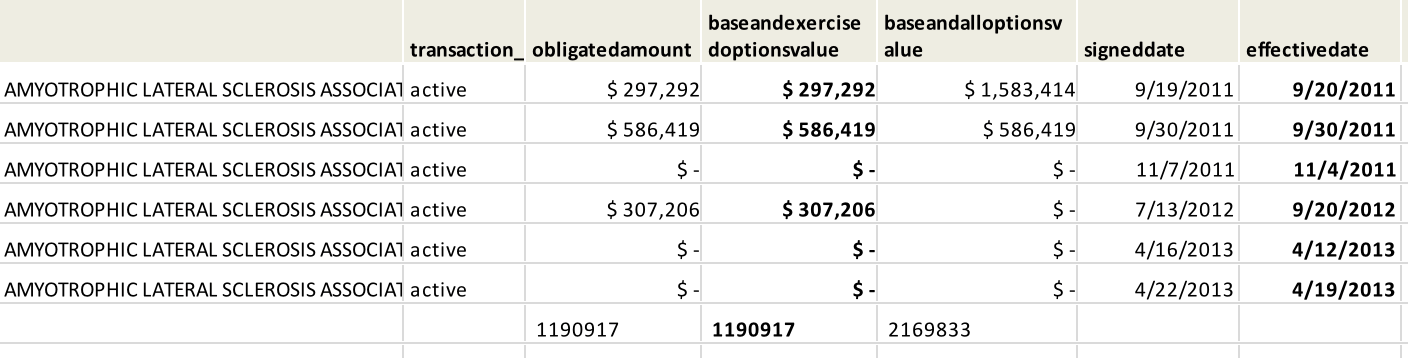
In November 2015, after another status inquiry, a large envelope appeared in my mailbox.  It contained a letter explaining some of information withheld along with a CD with two files.  A CD.  Who still has a computer with a CD drive?  Oh, well, I'm persistent.   Here they are: an ALSA contract and an MDA contract.  Both have information redacted, but there's plenty there to substantiate concerns about these sweet deals.


ALSA's Deal
.
The first contract was signed on September 19, 2011  Keep in mind that the Registry had been promoted by ALSA for years before that and that the online portal for people to self-enroll had been opened in 2010.

The contract purpose is pretty a pretty vague "to promote the National ALS Registry through an exptensive nationawide network of ALS Clinics, Chapters, and Certified Centers of Excellence."

The "technical requirements" provide us with some deliverables that are things and tasks (and not  Registry results).  ALSA will fulfill their responsibilities by doing the things many of us thought they should do as part of their mission that we already support with donations.  They are being paid to do tasks but there is no linkage to any results in increasing or even maintaining self-enrollment in the Registry.  It's a pretty sweet deal, especially when you don't have to bid. And it amounted at that time to over $1.5 million over five years.  But wait, there's more!

Less than two weeks after both parties signed the original contract, it was modified to an even bigger, sweeter deal.  The amount was increased to a redacted amount.  ALSA got the leeway to expand Registry education and outreach work to MLB, the NFL, MLS. And that has increased self-enrollment how?   Again, there was still no tie or performance expectation to maintain or increase self-enrollment in the Registry.

And the seeds of scope creep were planted.

And in this bigger, better version of the contract, the monthly compliance-reporting requirement in the first contract was suddenly changed to, "To be discussed at Kick-off Meeting."  OK, who was at that rather important Kick-off Meeting?

In both editions of the contract, there is a clear obligation that a contractor may not lobby for funding:


And we who go to the ALSA Advocacy Conference or who are online advocates hear about how great the Registry is from ALSA.  ALSA employees tell us to ask our legislators for another $10 million.  I suspect that through an intricate tapdance of who is on whose meter while talking to advocates, ALSA managed to fulfill the letter of that clause while defying its spirit.

There is also a requirement: "4.  Educate and train Contractor's local chapters' staff to identify ALS patients, increase awareness about the National ALS Registry, and if necessary, provide assistance in registry enrollment.  Contractor's chapter staff will not recruit ALS patients for the registry and will only assist with registration for those patients who request such assistance."  Read that paragraph a few times and scratch your head.

There are pages and pages in that pdf that was on the CD, and it's not easy reading for a lot of reasons.  By the time you plow to the end, you see a contract that somehow grew to $2.2 million.

A copy of some pages of the contract with my comments is here.  I will call them lowlights rather than highlights.

MDA's Deal

The MDA no-bid contract was dated September 12, 2013, two years after ALSA had received its no-bid contract.  The amount is a whopping $2,695,642 over five years.  It has another interesting clause:  "The contractor chosen must have direct and proprietary access to a high percentage of ALS patients in the United States."  Chosen?  Proprietary access?

In the base year MDA was to produce a Registry toolkit whose requirements are remarkably like we just paid ALSA to do.  Why not just use ALSA's, folks?

MDA got the same missive as ALSA to supply "relevant equipment" to district offices, clinics, and support groups help promote the registry.  There is no standard for "relevant equipment" nor is there any accountability.  That's kind of hard to swallow when we see how hard people with ALS have had to fight government rules to supply them basic communication technology.

MDA is also being paid to educate its own "stakeholders" about the differences between the CDC's ALS Registry and other ALS-related registries.  You see, MDA launched its own registry after the CDC's launched.  Now we pay the launcher to clear that up among its own "stakeholders."  Perhaps they can enlighten us on comparative data at the annual CDC Registry meeting sometime.

And maybe at the next CDC Registry meeting each invitee will introduce herself or himself as a project contractor, if appropriate.  And perhaps the patient and caregiver representatives will tell us which ALS organization nominated them for participation.

Our Deal

We got the dirty deal.  We got a national Registry with significant design flaws.  We got poor execution.  We got insider oversight and no accountability.  We got a project whose scope was allowed to creep to fit a very generous, unsubstantiated budget.  We got a project that continues to grow in search of things it might do well.  We got a cozy, secretive relationship that defies the spirit of government rules that prohibit agencies and contractors lobbying for funds.  We got a dirty deal.  People with ALS were fleeced.  We taxpayer-advocates were fleeced.  Or loofaed.

Sunday, November 15, 2015

Driving Ahead, Leadership, Risk, and the Importance of the Rear View Mirror

Last week I attended some of the ALS TDI Leadership Summit events.  It is clearly the most
welcoming conference for people with ALS and caregivers who are interested in science. Access to a variety of scientists, especially during break time and lunch, was outstanding.  Many of the conversations were candid and unfiltered, and that's a refreshing concept in the fight against ALS. Some miscellaneous impressions follow.


  • In the last decade it seems like we've gone through a full philosophical cycle -- From trying to understand a complicated disease to trying to throw things at it regardless of the rationale (just put out the fire) back to trying to understand the many things going on with ALS (figure out if it's a grease fire or an electrical fire).
  • The people with the most at stake in the fight against ALS don't have the benefit of a lot of institutional history.  Those with ALS and their loved ones are largely new at it.  Few with ALS live long enough to remember all that had been tried in the past, and organizations are not good at keeping the loved ones engaged for the long-term.  This provides some convenient blind spots when some of the science is explained.  
  • Many promising drugs have been screened and tested over the last decade, and there is an ever-growing dud pool.  Knowing about the volume and variety of duds is helpful to put the difficult road ahead into perspective.  And we have to be realistic that today's "promising" may well end up in the dud pool.  That doesn't mean stop.  It means that we need to smarten up and shorten the route.  
  • Fundraising is essential, and it's a lot easier to raise funds based on "promising" than it is looking at a rear-view mirror full of expensive duds.  Are we distorting the difficult road ahead by doing what's best for fundraising?  
  • People with ALS want to assume more risk, yet the scientists and clinicians aren't likely to step forward and lead that fight (or even lock arms with them as one man with ALS suggested).  I'm more convinced than ever that patient-led movements will cause the change in this area.  Organizations simply won't take the professional, public risks to be that bold in a heavily regulated field.
  • Having a gentleman with professional and academic chops on the afternoon panel was priceless.  The lithium story is one that has been subject to a lot of revisionist history.  Sometimes the establishment tries to tell that story in a way that makes the patients look gullible.  We had a person with ALS remind the panelists that the patients were the ones who showed that lithium didn't work.  People with ALS were the ones who begged everyone to stop wasting money on trials.  They should be respected for what they did.
  • We heard that small ALS trials are largely destined to fail. It sounds more credible when panelists say it.  Some people with ALS have been saying it for years.  We even heard that at one time some clinicians wanted a very small lithium trial destined to fail to make that problem go away.  There was some refreshing candor from Dr. Katz about the hype of some clinical trials.  At the end of that discussion on trial design, some of us in the audience had a serious question as to whether there is anything currently worth the investment in a clinical trial?  And I wondered what would happen to fundraising today if an organization would honestly say that there is nothing currently worth that investment?  

Depressing?  Not at all if you acknowledge the rear-view mirror and decide to take some new roads forward.   We need to learn not only from the duds but also from slow, inefficient processes.  

The father of a remarkable young woman with ALS asked if we are letting the perfect get in the way of the good.  That sums it up.  We need to forge ahead with admission of what's in the mirror and a willingness to take risk ourselves in many new ways so that people with ALS can take the risks that they accept (with eyes wide open) in order to move the science ahead faster.


Saturday, November 7, 2015

You Wouldn't Think Of Letting That Elevator Door Close


Especially when the waiting person is in a wheelchair.

Yet we close the door in the faces of those with ALS all the time.

Here's an example from twitter today.


It was an interesting article on the virus theory that has been in the news lately.  A woman with ALS responds below.  She's interested in the trial cited in the article.  The article failed to contain trial contact information for those who actually have ALS.


On a long shot, I searched clinicaltrials.gov.  Odds were that I wouldn't have the right keyword for the products involved and wouldn't find it.  I got lucky and found it.


Everything is hard for those with ALS.  Life would be so much better for them (and quite frankly, trials would be filled much sooner) if people would simply make sure that they're holding the door open for those who don't need more barriers in their lives.

After all, they are why you're doing the science that is published in the first place.


Friday, November 6, 2015

It's Much More Than A Game

I live in an NFL city that has a team that set high expectations and has performed terribly this year.

Everybody has an opinion about the problem --

The GM is the problem.
The coach is the problem.
The offensive coordinator is the problem.
The QB is the problem.


And with every assessment of "the problem," there is an expected action that someone will be let go and changes will be made.

I live in a world of ALS that has teams that have set high expectations and have yet to deliver a big win.

It's much more than a game.

Do we ever assess "the problem" and take expected actions?

Ever?

Thursday, November 5, 2015

There Really Is Educational TV

Last night Charlie Rose featured a segment with Dr. Collins of the NIH and then another with PALS Jay Fishman and Dr. Rothstein.  It was late.  After a few hours of sleep, a few very random thoughts are stuck in my mind.

  • NIH funding is precious.
  • Why were NIH funds needed for this new report?  ATSDR has generous funding for the Registry.
  • The delay to diagnosis for ALS is outrageous.  Charlie Rose grasped it.  Jay Fishman lived it.  Dr. Rothstein didn't want to cast aspersions on the fellow physicians who fail to diagnose it. That delay to diagnosis is costly in many ways, and the patient is the one who pays the price, yet we give physicians a professional free pass when they miss it, and they often miss it.
  • The ALS Ice Bucket Challenge missed opportunities.
  • We need better accounting and accountability in the fight against ALS.
  • Money won't cure a disease that is short on new ideas.
  • The cure isn't "around the corner."  I took that to mean that Dr. Rothstein has no impending  treatment for Mr. Fishman.  I appreciated the candor.
  • Too bad the conversation didn't then jump on shortening "the corner" by getting experimental drugs to PALS much more quickly.
  • Charlie Rose is on too late in my city. 
  • Jay Fishman has an attitude that reminds me of my mother when she faced ALS.

We need to have more serious conversations and more action to change the status quo.  Thanks, Mr. Fishman.

Wednesday, October 21, 2015

What Would You Fight For? This!

I was more than pleased to receive the email below.

To have neuroscience students interested in this beast of a mystery disease is so important! And those of us fortunate enough to be graduates of the University of Notre Dame have a big added dose of joy to see them raising awareness, research funds, and their prayers to fight ALS.  It is a special place and so many alumni, family members, and friends of the school (and its rivals) have been lost to ALS.

Please participate.  The campus is gorgeous in the fall and is not far from a lot of major cities in the midwest.  And the t-shirts are awesome.  Please support these students.  Thank you.  Go Irish!  Beat ALS.

Hi!  My name is Chris Ferari and I am a junior at the University of Notre Dame as well as one of the officers of the new Neuroscience Club on campus.  I am very excited to announce that this year the Neuroscience Club will be hosting the 1st Annual Notre Dame ALS Walk, co-sponsored by the College of Science!  This scenic approx. 2.7 mile walk around campus will begin and end at Jordan Hall of Science and include a short group prayer in the grotto.  Here are the details of the event:
 When: October 31st, 9-11 AM
Where: Across campus, beginning and ending at Jordan Hall of Science
Who: Notre Dame students, faculty, and friends
 We are incredibly excited about starting this walk on campus, and we hope that it can become a yearly opportunity for the Notre Dame community to raise money for a damaging neurological disorder that has affected many members of the Notre Dame family.  Please consider donating to or attending this special event!  Thanks in advance for your support!
 Go Irish!!!
Chris Ferari

Saturday, October 17, 2015

We Need To Flip The Orbits

Often I wonder how some ALS organization employees or board members can be so out of touch.  Are they not paying attention, especially to issues and concerns that are so apparent to people with ALS and caregivers and advocates on the internet?

We have a kind of solar system where organizations have placed themselves the shining stars of the internet, providing messaging and resources for those who orbit their sites.  They build.  People with ALS and caregivers come to orbit them.  They occasionally stave off rogue planets that appear to go astray.  The star shines at the center of its solar system and can burn off stray matter.

Who knows what those organizations and board members could be if they revolved online around people with ALS and caregivers for a change.  You see, it's about PALS and CALS. With the tools that today's internet provides, we should all be orbiting the thoughts and needs of people with ALS and their caregivers.  They really are the stars.  Everyone should get in touch with that concept.  Orbit them.  Get in touch.  


Monday, October 12, 2015

Please, Stop The Information Waste!

People with ALS try things.  It's a fact.  Some things are pretty innocuous and other things are more complicated.

Families rely a lot on Dr. Google to find things to try.  They search.  They try to sort thought it all.  They are fighting a terribly fast clock.  The information they seek is in stunning disarray.

Mom read that Vitamin E might help ALS.  I got her a bottle of liquid Centrum with Vitamin E at Walgreen.  Later that same day I read in My Luke and I by Eleanor Gehrig that they had tried Vitamin E.  We were doing the same #$%^&*  thing that Lou Gehrig tried in 1939.

The information gaps have us blindly trying the same things over and over.

We need to capture information.  We need to let the data speak.  PALS need to be encouraged to self-report their information in a public and organized and searchable manner.

PALS and CALS are vulnerable to hucksters, and often on the day of diagnosis they are warned of
predators who will want to replace their fillings or shoot some fat cells into them.  And new PALS and CALS are often frightened by their clinic staffs and ALS organizations on the perils of the internet.

This is so wrong.  It is so wasteful.  Instead why don't we encourage some productive use of the internet (beyond the miracle of fundraising)?

Let the data speak.  If everyone who had fillings popped out self-reported on results, it would give PALS information for more intelligent choices.  If everyone who tried Vitamin E self-reported on results, it would let PALS make more informed decisions.

Please, let the data speak.

Ironically, www.alsuntangled.com has been using self-reported data at www.patientslikeme.com where the data contributions from PALS seem to have dropped off severely in recent years.  The ALS establishment needs to encourage the self-reporting rather than frightening PALS away!

People with privacy concerns can be as obscure in their personal identities as they want.  A right-handed ballerina can call herself "Lefty" and post her data at patientslikeme.  I cite that website simply because it has a good data presentment dashboard for those with ALS.

The information waste we are experiencing today is insane.  It is wrong.  Self-reported data are not perfect, but with a fatal mystery disease with no good treatment options, the imperfect data are valuable.  To bury clues with PALS is just madness.

And perhaps it's time for all involved in the fight against ALS to ask PALS why they aren't self-reporting data today.

Let the data speak.  Let PALS make more informed decisions.  Give scientists a clue, too.  Please.  Information is a terrible thing to waste.